Monday, July 2, 2018

Meet the Real Estate Tech Founder: Steven Wynands from Peer Reputation

In our latest real estate tech entrepreneur interview, we’re speaking with Steven Wynands from Peer Reputation. Steven is another recent addition to the Geek Estate Mastermind.

Without further ado…

What do you do?

I am the Co-founder and CEO of Peer Reputation. We’ve created something that will finally raise the bar of the real estate industry.

What problem does your product/service solve?

It’s too easy to become a real estate agent. It’s much tougher to be a good one. We’ve developed the only reliable way to verify agent quality: anonymous post-settlement reviews between cooperating agents (i.e. Peer Reputation).

This is groundbreaking because consumer reviews only begin to scratch the surface and can be easily gamed (as you’ve mentioned). Checking Zillow reviews is like asking your friend which doctor they go to.

Checking Peer Reputation is like asking your doctor who he would go to for surgery.

What are you most excited about right now?

Industry response has been overwhelming! We have over 5,600 registered users and 80,000 feedback responses (156% CMGR over 5 months and 19% CMGR over 9 months, respectively). Our email analytics show an open rate of 74% and a click rate of 27%! I’m excited to see this fast adoption and willingness of agents to participate. We clearly have the momentum, willingness, and capability to improve the industry, and we’ve only just begun. There are 380+ metro areas in the US. We are only in 10 of them and have data ready to launch in 44 more areas.

What’s next for you?

We have so many exciting plans. While we continue to expand, we’re building out features that help good agents earn more business and ratify more contracts. We need to get the negative ratings into the hands of brokers so they can provide the necessary training to their agents. We’ve also been asked to develop recruitment and retention features for brokers.

What’s a cause you’re passionate about and why?

I believe the children are our future.

Children hold the greatest potential in making a positive difference in our world because they possess the most unadulterated optimism. We need to give them the tools and support to do things better than we did. I’ve been mentoring youth since I was in high school. Nowadays that energy is focused on my 3 and 5 year olds.

Meet The RE Tech EntrepreneurThanks to Steven for sharing his story. If you’d like to connect, find him on LinkedIn here.

We’re constantly looking for great real estate tech entrepreneurs to feature. If that’s you, please read this post — then drop me a line (drew @ geekestatelabs dot com).

The post Meet the Real Estate Tech Founder: Steven Wynands from Peer Reputation appeared first on GeekEstate Blog.


from GeekEstate Blog https://ift.tt/2KFjQNg

Sayonara, business cards: LinkedIn offers QR codes and translations

New LinkedIn features make it even easier to instantly connect with those you meet—no matter what language they speak.

The social media platform recently announced QR codes for profiles. Open the app on your smartphone or mobile device, and scan the person’s code to visit his or her profile, where you can send a connection request.

Alex Xiong, senior product manager at LinkedIn, wrote in the company blog:

Whether you’re at an industry conference, networking happy hour, sales meeting, or social gathering, we know how tough it can be to remember names and exchange contact info so you can stay in touch afterwards. Connecting on LinkedIn is a great way to build your professional community, and we want to help make this even easier for you — wherever those connections take place.

… The next time you’re at an industry event and meet someone that you want to keep chatting with, open the LinkedIn app and scan their QR code to connect and stay in touch. Gone are the days of requesting a business card, asking the person to spell their name, or handing over your phone to make sure you found their profile.


[FREE DOWNLOAD: 10 techniques to beef up your networking]

You can find your own QR code by clicking on the QR icon in the top of the home tab (within the search box). From there, you can share it in a plethora of ways.

Xiong wrote:

There are a bunch of creative ways you can use your LinkedIn QR code to build your professional community and continue your offline conversations online. For example, put your LinkedIn QR code on brochures and event materials, on your website, on conference badges or lanyards, in your email signature, or directly on your resume.

If you’re connecting with international audiences, LinkedIn has also made it easier to network online and share insights on its platform.

Posts that are in a different language than you speak will now show a “See Translation” button within the LinkedIn Feed, the recent activity section on someone’s profile, and the post detail page.

LinkedIn senior product manager Zack Hendlin wrote in the company blog:

We show you the “See Translation” option based on signals such as your language setting, the country you’re accessing LinkedIn from, the languages on your profile, and other factors. We then compare it to the language we’ve identified a post as having to see if you might need it translated. These translations are powered by Microsoft Text Analytics API, an Azure Cognitive Service, which also powers translations for Bing, Skype, and Office. And since Microsoft is continually improving translation quality, you can expect translations to get better and better over time.

The “See Translation” feature is available in more than 60 languages including Spanish, Japanese, and German to a majority of global members on desktop and mobile web. This feature will be coming in the next few weeks to the LinkedIn iOS and Android apps, and we’re constantly growing the languages supported.

The features simplify and expedite the networking process—guaranteeing more for building relationships instead of hunting for potential connections.

TechCrunch reported:

In both cases, the features are likely overdue. The lingua franca of LinkedIn seems to be English, but the platform has a large global reach, and as it continues to try to expand to a wider range of later adopters and different categories of users, having a translation feature seems to be a no-brainer. It would also put it in closer line with the likes of Twitter and Facebook, which have had translation options for years.

The QR code generator, meanwhile, has become a key way for people to swap their details when they are not already connected on a network. And with LinkedIn this makes a lot of sense: there are so many people with the same name and it can be a challenge figuring out which “Mark Smith” you might want to connect with after coming across him at an event. And given that LinkedIn has been looking for more ways of making its app useful in in-person situations, this is an obvious way to enable that.

The announcements also underline the increasingly digital nature of personal branding and content. You can use the platform to land your dream job, but many communicators use it to share their organizations’ content and updates with consumers and increase their personal visibility and influence through LinkedIn posts.

With LinkedIn’s QR codes and translation services, you might no longer require carrying business cards to your next event or meeting.

TechRepublic reported:

Many companies have tried to digitize or replace business cards in the past. The website About.me was one of the most well-known, but apps like BizzCard and SamCard also gave it a shot, with varying levels of success.

LinkedIn's established popularity could give it an edge in finally doing what others before it have tried to do—killing the business card. At tech conferences, at least, it is common to hear the phrase "Let's connect on LinkedIn." Now, that can be accomplished almost instantly, without the need to tally up business cards at the end of the night or try to remember when the interactions took place, or what was talked about.

PR and marketing pros should take advantage of these features by making sure their LinkedIn profiles shine. Start with these tips to make your profile smart and snappy and then follow this advice to ensure your profile opens up even more opportunities.

(Image via)


from PR Daily News Feed https://ift.tt/2KCA2ln

Share the impact of your CSR initiative


from PR Daily News Feed https://ift.tt/2tMbOf9

How to get high response rates from influencer outreach

How would you like to achieve response rates of 50 percent (or higher) for your influencer outreach?

It’s possible—if you put the work in before sending that email. Here’s a four-step process for achieving sky-high response rates:

1. Invest time in choosing the right influencers.

You are better off with a list of 10 relevant, niche influencers than with 100 mega-influencers who don’t care about your brand or your story.

Make a shortlist of people who’d be a smart, sensible fit for your campaign.

There are many ways to find influencers, but here are four that work really well:

Use Brand24 to track relevant keywords. For Twitter mentions, the tool will outline the influencer score of the person tweeting. This means you can identify influential people who are sharing content relevant to your brand.

Use GroupHigh to search through 15 million blogs. GroupHigh can deliver crucial insights on bloggers’ domain authority, social media followers and interactions, and much more.

Find out who influencers are talking to regularly. Twitonomy lets you enter the Twitter address of an influencer, and the tool will show you who the influencer is interacting with most—typically other influencers.

Use Ahrefs to find websites ranking for your top keywords. Enter the keywords you’re keen to track, and Ahrefs will reveal the top websites ranking for them.

If you see the same website appearing repeatedly for your keywords, it could be a competitor or influencer creating content about those topics.

[RELATED: Join us for our 10th anniversary of the Employee Communications, PR & Social Media Summit at Microsoft]

For example, the snapshot below shows websites that are ranking for “digital marketing.” Whom would you contact for a potential partnership?

2. Start interacting with influencers and figuring out their interests.

Your response rate will soar if the influencer knows who you are or has interacted with you before.

Here’s what to do before sending your first outreach email:

  • Start monitoring their social media feed.
  • Connect on LinkedIn.
  • Read and comment on their blog posts.
  • Find timely, relevant news items worth talking about (which you can mention in your outreach).
  • Track their blog content using Feedly, and share their latest blog posts.

Try to be active on channels that influencers frequent. Start a meaningful conversation, and find ways to add value so they respond and remember your name.

3. Reach out with a friendly email.

Personalization, being helpful and making a simple request are vital to the success of your influencer outreach campaign. You can send emails manually or use an email outreach tool that will speed the process and help track results.

Personalization

Your outreach email should contain at least three pieces of information that show you’ve done your research. For example:

  • Reference the influencer’s website.
  • Cover topics they write about or have recently written about.
  • Mention something specific that they do or have done.
  • Reference where they are from.

Spending time on research, learning about the influencer and personalizing your message will set you apart from those who blast generic emails to everyone.

Being helpful

If you can somehow help an influencer in your first email, it’s likely you’ll get a response. Then you can start a proper conversation.

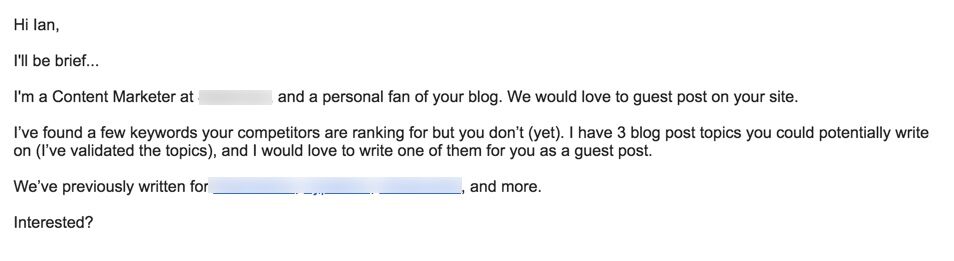
Here’s a smart outreach email I recently received. It didn’t provide immediate help, but there was a promise in there that sparked my interest:

The email states they could help me rank for the keywords my competitor ranks for, so this was a great way to get my attention and start a conversation.

Small request

“Please review my product,” is not a small request. You’d be asking for a big chunk of the influencer’s time.

Instead, notice that the last line of the outreach email above is “Interested?” This means the influencer just has to answer yes or no.

The goal of first outreach email is to get a response. It’s not to generate a sale, get an article published or get a link. Just get that initial response, and get the ball rolling.

4. Follow up if you don't get a response.

How often do you receive an email that you forget to answer or just don’t have the time to read?

A gentle nudge sometimes works. If you don’t get a response the first time around, you should send one  follow-up email three to five days later that contains the original message and a quick reminder, such as:

“I know what it’s like getting too many emails. If you get a chance to respond to my email below that would be awesome!”

You can give it one more shot about five days after this. In a second follow-up, try taking a different approach with a completely different email.

Takeaways

Influencer outreach can help you expand your business, but there are no shortcuts to success. Take time to find the right influencers who will resonate with your specific audience, and go the extra mile to woo them with a promising pitch.

Which influencer outreach tactics have worked for you? Please share your best practices in the comments.

Ian Cleary is founder of the content marketing agency RazorSocial and the email outreach tool OutreachPlus.

(Image via)


from PR Daily News Feed https://ift.tt/2lPoygA

Sunday, July 1, 2018

Infographic: 20 tips to keep website visitors’ attention

Content marketers have a prime objective: Get online users to stick around.

Whether you seek to create more dynamic content or offer engrossing experiences that overwhelm your audience, you want to keep your audience coming back for more. Online publishers can take key steps to keep bored users from crashing out of your website.

[RELATED: Distracted audiences? Mind-numbing topics? Cut through the clutterwith creative corporate writing.]

This infographic from Quicksprout offers 20 tips on how web designers and brand managers can keep users on their websites and minimize bounce rates.

It includes:

  • Set realistic expectations.
  • Target the right customers.
  • Speed up the page loading times.
  • Deliver [high-]quality content.

To learn how to keep consumers coming back to your website, see the full infographic below.


from PR Daily News Feed https://ift.tt/2IJaNZO

24 Ways to Save Money in Paris in 2018

Beautiful landmark on a sunny day in Paris, France
Updated: 07/01/2018 | July 1st, 2018

Uncorking a bottle of French wine on a sunny day, spreading brie on a baguette, gazing out on the Paris skyline in front of the Sacré-Coeur in Montmartre — to me, that’s the perfect day. Paris is one of my favorite cities in the world thanks to its cobblestone streets lit up at night under the glow of street lights, historic architecture, incredible music, savory delicious food, and smartly dressed locals. Paris is a city I just melt into.

But Paris is also a city that melts the wallet. With the city’s plentiful restaurants, bars, and attractions, your money can disappear quickly if you aren’t smart. Luckily it doesn’t have to be that way, and there are plenty of ways to enjoy Paris without experiencing sadness over a suddenly empty bank account. Below are 22 ways to save big money on your next visit to the City of Light:

1. Visit the Louvre for free — Admission to the famous Louvre Museum is free the first Sunday of each month from October to March. Moreover, to avoid the massive ticket lines, enter via the Carrousel du Louvre entrance and you’ll get right to the ticket counter. You can also skip the lines if you have a Paris Museum Pass.

2. Save at the Musée d’Orsay — Tickets to the museum are only €8.50 after 4:30 p.m. (except on Thursdays, when they’re reduced to €8.50 from 6 p.m. until 9:45 p.m.). Entry is also free the first Sunday of the month. Regular ticket prices are €11.

3. Buy a Paris Museum Pass — I’m a huge fan of tourist cards, and Paris is one of the best places to get one. There are so many museums and attractions worth seeing that ticket prices can really add up quickly. The Paris Museum Pass will help. It offers free and discounted admission to 60 museums and monuments around the city, and it lets you skip the ticket lines! Prices: €42 (two days); €56 (four days); €69 (six days). It pays for itself after three museums. Heck, the Palace of Versailles is €20 alone! Get this ticket if you plan to see at least three museums!

4. First Sunday of the month? Free museums! – If you happen to find yourself in Paris on the first Sunday of the month between October and March, most of the city’s major museums offer free admission. During the other months, admission is free for those under 26 and in the EU. The Louvre is free on Friday nights for everyone. The downside is that they will all be super crowded as this is no secret! Here’s a list of museums that participate:

  • Musée National d’Art Moderne – Centre Pompidou
  • Musée des Arts et Métiers
  • Musée de la Chasse et de la Nature
  • Musée National Eugène Delacroix
  • Musée National Gustave Moreau
  • Musée National Jean-Jacques Henner
  • Musée National du Moyen Âge – Thermes de Cluny
  • Musée National de l’Orangerie
  • Musée d’Orsay
  • Musée National Picasso
  • Cité de l’Architecture et du Patrimoine
  • Cité Nationale de l’Histoire de l’Immigration
  • Musée du Quai Branly – Jacques Chirac
  • Musée National des Arts Asiatiques Guimet

A photo of the pyramid which was designed by IM Pei at the Louvre, a popular museum in Paris

5. Take public transport from Charles de Gaulle — Save money right when you land by taking public transportation into the city. You have two options:

  • Take the RER B (regional train): This option costs €9.50 and takes 25–50 minutes (depending on your destination and whether you get an express train). Once you get into the city, you can transfer to the metro to reach your final destination.
  • Take a bus: The “RoissyBus” costs €10 per person and takes 45–60 minutes.

I prefer the RER, but depending on where you’re going, the bus might be more direct as you may not have to transfer to a local metro.

6. Skip taxis — The subway system in Paris is very extensive and can take you anywhere you need to go. Don’t waste money on overpriced taxis.

7. Buy a 10-pack of metro/bus tickets — Bus and metro tickets cost €1.70 each. However, you can purchase a “carnet,” which is a pack of 10 tickets costing €13.70. It saves you €3.30 — a modest saving but better than nothing!

8. Take the Vélib’ — Paris’ bike-share program boasts over 20,000 bikes at 1,800 stations located throughout the city. You join by purchasing a one-day pass for €1.70 or a one-week pass for €8. You’ll need a pin and chip card to use the machines. If you don’t have that type of credit card, you can buy a ticket online and use your access code at the stations!

A view from above of the gorgeous Champs Elyses, a famous walking street in Paris

9. Stay in hostels — Hostels offer great accommodations for those on a budget, especially since most hotels in Paris are beyond expensive. Dorm rooms in Paris start at €15, and private rooms in hostels begin around €50.

10. Drink in hostels — Even if you aren’t staying in hostels, you should still consider drinking at their bars. They offer amazing happy hours with beers as little as €2. They’re a great place to start your night out in Paris without busting your budget.

11. Couchsurf — Nothing’s cheaper than sleeping for free. Couchsurfing connects you with locals who will give you not only a free place to stay but can act as a local tour guide who can introduce you to all the hidden places around the city that only a local will know. To me, it’s one of the greatest ways to really get to know a city.  (If you don’t want to stay with people, there are always tons of events going on so you can at least use it to meet some locals!) Here’s a guide to using Couchsurfing!

12. Visit the free sights — The city has a lot of free attractions, including museums like the Musée d’Art Moderne, Maison de Balzac, and Maison de Victor Hugo, most churches, and parks like the Jardin du Luxembourg. You’ll find a lot of places in Paris to visit for free. Musee Carnavalet (the Paris History Museum), the Musee d’Art Moderne de la Ville de Paris, the Musee de la Prefecture de Police (Police Headquarters Museum) and the Fragonard Perfume Museum.

13. Take a free walking tour — Free walking tours of Paris’s central sights are available from several tour companies. My favorite is New Europe Walking Tours. There’s also Paris Greeters, where locals lead you on a free tour of their city. It’s modeled after the one in New York. Be sure to tip your guides!

14. Remember that water is free! — When you order water at a restaurant, make sure you ask for tap water. They’ll try to provide bottled water and charge you for it, but tap water is free and safe to drink.

15. Get the set lunch menu — If you eat out, do so at lunch and get the prix fixe menu (two- or three-course set menu). Restaurants throughout town offer this set menu during lunch, and with prices between €10 and €20, it’s a way better deal than the regular dinner menu!

16. Pick up lunch at outdoor markets — Paris is a market city, with food markets throughout town. If you want to save big money on meals, head to one of the markets, pick up some cheese, wine, bread, meats, or anything else, and head to the park for a picnic. (Or grab a sandwich for later!) You’ll find the locals doing the same thing, and it’s one of the cheaper ways to get a true taste of French food.

People dining at a street cafe in Paris France

17. Head to the grocery store for basics — Grocery shopping is a no-brainer way to eat cheap. They have all the ingredients you need for basic foods as well as prepared meals. They sell wine too!

18. Enjoy free summer festivals — During the summer, you can find free entertainment almost any night of the week, such as the Paris Jazz Festival and outdoor film screenings like Cinéma en Plein Air.

Black and white photo of a beautiful alley in Paris, France

20. Use Airbnb — Don’t want to sleep in a stranger’s home or a hostel? Airbnb offers the next cheapest accommodation options. This site allows you to rent a room or entire apartment in a Paris neighborhood. You get all the comforts of home! I’ve seen entire apartments for as little as $70 a night. Split that a few ways, and it’s cheaper than a hostel!  (If you’re new to Airbnb, get $35 off your first stay!)

Note on Using Airbnb: Airbnb has dramatically raised the price of rents and pushed out locals in the city as people have started to buy multiple properties in order to rent them out to tourists. I strongly encourage you to only use Airbnb if you are renting a room in someone’s house not an entire place. Airbnb has pushed out the locals you want to interact with. It’s too hard to determine if that entire home you’re renting is really someone’s private residence or a rental property owned by a giant company. Help end overtourism.

21. Fill up your water bottle around town — Paris has more than 800 water fountains located throughout the city where you can fill your water bottle.

22. Avoid shopping — Unless you’re a trust-fund baby, avoid shopping in Paris. High taxes and labor costs make everything more expensive than it needs to be. There’s nothing in Paris you couldn’t find a similar version of in your home country at a much cheaper price. Save your money and use it for experiences, not stuff.

23. Eat away from the tourist centers – There are so many world class restaurants in Paris that if you stick to eating close to where the tourists are, you’ll eat terrible food and have terrible service. There’s like an invisible line tourists never seem to cross. My rule: always walk five blocks away from any tourist sight to find good local cuisine. Find good and cheap food on websites like La Fourchette, Yelp, and The Fork (which offers discounts up to 50 percent at more than 1,000 restaurants across Paris) and like a Parisian.

24. Check the local tourism office for free stuff – The local tourism office’s job is to save you money and help you plan your way around the city. They are a grossly under utilized resource by travelers. They know everything going. Go into their office, ask questions, find free things, and get discounts on tours and attractions throughout the city.

***

Paris is an expensive city and traveling Paris on a budget has become harder in the last couple of years. But, like any major city, there are plenty of budget options if you know where to look. By making a few small adjustments, you can find big savings that will make any trip to Paris fun, affordable, and memorable.

NEXT STEP—–> Click here to get my detailed insider’s guide to Paris. Save more money, get away from the crowds, and have the ultimate Parisian adventure!

The post 24 Ways to Save Money in Paris in 2018 appeared first on Nomadic Matt's Travel Site.


from Nomadic Matt's Travel Site https://ift.tt/2KzlenS

Meet the Real Estate Tech Founder: Robert Moore from Workframe

In our latest real estate tech founder interview, we’re speaking with Robert Moore, the co-founder/CEO of Workframe.

Without further ado…

What do you do?

I’m the Co-Founder and CEO of Workframe, a company I started with Andy Parsons (our CTO) and Matthew Smith (our CPO). We’re veterans of the New York City technology scene who grew frustrated with the process of building out and operating the office spaces of our previous companies and vowed to develop a solution.

Workframe is the only workflow optimization solution purpose-built for the commercial real estate (CRE) industry. Our intuitive, web-based software application helps large corporate tenants, landlords, brokers and service providers gain unprecedented visibility into their project workflow and presents them with actionable data that can be leveraged to drive efficiency and cost savings.

The application serves as a single system of record for CRE initiatives of any scale – from major capital projects to minor renovations, our customers are able to easily monitor progress, track major deliverables, record approvals and communicate around critical documents across their portfolio of projects. By replacing inefficient channels of communication, we’re able to provide unparalleled levels of transparency and accountability that contribute to driving a more efficient process.

What problem does your product/service solve?

CRE is a heavily intermediated industry with a unique set of workflow and communications challenges. To find, design and build out a new office space, corporate tenants have to coordinate with their internal teams and a slew of third party consultants (architects, MEPs, general contractors, AV/IT professionals, etc.). The Director of Real Estate for a large multinational company may be overseeing a regional project from afar while simultaneously managing several other high stakes initiatives, which makes effective collaboration exceedingly difficult.

When we dug into the problem, we realized that there really wasn’t an existing solution that can adequately handle the complexity of the commercial real estate (CRE) project lifecycle and – more importantly – that there is a massive market for such a solution.

What are you most excited about right now?

We recently announced a strategic partnership with Newmark Knight Frank and are in the process of determining the best way to roll out our platform across their business. Brokerage is a relatively new use case for us, and it’s always exciting (and validating) to uncover additional applications of our software in the marketplace.

What’s next for you?

We’re releasing a significant update to our platform later this summer, which is geared toward larger corporate tenants that manage diverse portfolios and complex initiatives. Beyond that, we’re focused on scaling the business nationally (and internationally) and continually improving our product in ways that deliver value for our customers.

What’s a cause you’re passionate about and why?

I’m a big believer in enabling employees to get involved in causes that are important to them. At Workframe, we give all employees additional personal time off each year to give back to the community through a charity or other organization of their choice. As the founder of a high-growth startup and father of two young children, I don’t always have as much time as I’d like to pursue issues I’m passionate about outside of the office – but I take pride in knowing that we’ve created a workplace that encourages community involvement.

Thanks to Robert for sharing his story. If you’d like to connect, find him on LinkedIn here.

Meet The RE Tech EntrepreneurWe’re constantly looking for great real estate tech entrepreneurs to feature. If that’s you, please read this post — then drop me a line (drew @ geekestatelabs dot com).

The post Meet the Real Estate Tech Founder: Robert Moore from Workframe appeared first on GeekEstate Blog.


from GeekEstate Blog https://ift.tt/2z1QCXm