Tuesday, September 4, 2018

10 surefire ways to ensure your next crisis spirals out of control
All organizations are vulnerable to crises.
Disasters, lawsuits, accusations of impropriety, sudden changes in ownership or management, and other volatile situations can and often do happen. The threat of serious damage to people, property and/or reputation is real for any organization, and for many individuals as well.
The cheapest way to turn experience into future success is to learn from others’ mistakes.
[FREE GUIDE: 3 things you (probably) didn't know about crisis communications]
The following examples of inappropriate crisis communications policies, culled from real-life situations, should provide a tongue-in-cheek guide to the mistakes you must avoid. If you want your crisis to spiral out of control, employ any combination of these wrong-way tactics:
1. Play ostrich. Do what Lance Armstrong did for years: Hope that no one learns about it. Follow the advice to say nothing and do nothing. Assume you’ll have time to react when and if necessary, with little or no preparation time. While you’re playing ostrich, with your head buried firmly in the sand, don’t think about the part that’s still hanging out.
2. Don’t start work on a potential crisis until after it’s public. Even if you’ve decided you won’t play ostrich, you can still fuel a developing crisis by shunning advance preparation. Before the situation becomes public, you have proactive options available. You could, for example, flesh out and even test some planned key messages, but that would mean that you could communicate promptly and credibly should a crisis break publicly, and you don’t want that, do you? So, to allow your crisis to gain a strong foothold in the public’s mind, make sure you address all issues from a defensive posture. Shoot from the hip, and give off-the-cuff remarks.
3. Let your reputation speak for you. That worked out so well for the now-defunct Arthur Andersen, once one of the largest accounting firms in the world—before Enron.
4. Treat print and online journalists as the enemy. We see examples of this every day. By all means, tell a reporter or social media activist that you think they have done such a bad job of reporting on you that you’ll never talk to them again. You might badmouth them in a public forum or send nasty emails or texts. (Better yet: Badmouth an entire news organization.)
Then sit back and have a good time while your target:
-
- Gets angry and directs that energy into intensively going after your organization
- Laughs at what they see as validation that you’re up to no good
5. Rely on outside forums to tell your story. Because you’re eager to have others write about you accurately, tell your story only to mainstream journalists and social media influencers. They’ll tell your story properly—some of the time. Why bother setting up a website or other communications channels where you control the message 100 percent?
6. Use language your audience doesn’t understand. Jargon and arcane acronyms are but two ways to confuse your audiences, ideal for making most crises worse. Here are a few gems taken from actual announcements:
-
- I’m proud that my business is ISO 9000 certified.
- The rate went down 10 basis points.
- We ask that you submit exculpatory evidence to the grand jury.
- The material has less than 0.65 ppm benzene as measured by the TCLP.
For the average member of the public—and for journalists who don’t specialize in that particular subject—the general reaction to such statements is, “Huh?”
7. Don’t listen to your stakeholders. Make sure all your decisions are based on your best thinking alone. After all, how would feedback from your clients/customers, employees, referral sources, investors, industry leaders or other stakeholders be useful in determining how to communicate with them?
8. Assume that truth will triumph over all. You have the facts on your side, by golly, and you know your stakeholders will eventually come around and realize that. Disregard the notion that perception is as damaging as reality—sometimes more so.
9. Address only issues, and ignore feelings. Have you ever tried to resolve a significant issue with a loved one by using logic alone—assuming the facts, as you presented them, would sway their perspective, without any acknowledgement of their feelings? Given that you know how well that works, take the same approach to external communication.
10. Ignore those who are savvy about online channels. You neither use nor care about social media except to learn what your kids are doing via Facebook, and you still struggle to understand how “all things internet” really work. Who cares about Twitter, except feuding politicians and celebrities, right? LinkedIn is just somewhere job hunters can hit you up for work, of course. And why would Instagram be important except to “kids”? Because all your stakeholders feel exactly the same way, then optimized use of technology and online communication to prevent and respond to crises isn’t important.
You can choose to feed your crisis—or you can learn from others’ mistakes. It’s a conscious choice that will have a direct impact, for better or worse, on the future of your organization.
A version of this post first appeared on Bernstein Crisis Management.
(Image via)
from PR Daily News Feed https://ift.tt/2Ne4SlD
Monday, September 3, 2018
Infographic: Why micro-influencers make sense for marketers
When it comes to influencer marketing, less is often more.
Having an influencer with millions of viewers showcase or mention your product or service might sound wonderful, but will your target audience even be watching?
Micro-influencers, with their smaller—but more devoted—follower numbers, command incredible engagement and trust from their niche audiences. Working with them allows brand managers to reach targeted groups that are related to their industry.
[RELATED: Overcome your biggest challenges in social media, PR and internal comms]
Still unconvinced? SocialPubli dives into the data that prove you should be investing in micro-influencers rather than internet celebrities with enormous follower numbers in this infographic.
It includes:
- Engagement rates on Instagram and Twitter decline as follower numbers increase.
- Eighty-seven percent of global consumers say brands should “act with integrity at all times” and micro-influencers produce more authentic content that their niche audiences trust.
- For the price it costs to work with a “mega-influencer” (those with more than 1 million followers), brand managers could afford working with more than 40 micro-influencers.
Check out the full infographic below to discover why smaller can be better for your influencer marketing strategy.

from PR Daily News Feed https://ift.tt/2Q1Z1yw
Meet the Real Estate Tech Founder: Ken Robbins from Millie
 In our latest real estate tech entrepreneur interview, we’re speaking with Ken Robbins from Millie. I first heard about Millie a couple years ago when they were selected for FWD in 2016, and have long thought a strategic, focused effort on military housing and real estate is a compelling opportunity, that somehow most have missed. We’re thrilled to have him as a member of Geek Estate Mastermind.
Without further ado…
What do you do?
I am the CEO and co-founder of MILLIE, a real estate marketplace that connects military and veteran movers with trusted resources providers who have been in their shoes.
What problem does your product/service solve?
Every year, the Department of Defense moves nearly 500K military families around the globe with little assistance other than the movement of their house hold goods. Additionally, veterans and active military account for nearly 20% of the home buying market every year and we realtors struggle with communicating effectively with this market.

What are you most excited about right now?
Our new product Agent Intel. It is truly a game changer for those real estate agents that want to more effectively communicate their value proposition to the veteran and military market. Also, we are helping to ensure that more veterans learn about their VA home loan benefits, which allows them to participate in the American dream of owning their own home.
What’s next for you?
We are laser focused on getting the word out on Agent Intel to the entire real estate community. I am bringing on a rock star veteran who is a top performing agent to be the face of Agent Intel. She will be able to really help us ensure we are meeting the needs of our community members.
What’s a cause you’re passionate about and why?
Well, my personal and business life are pretty intertwined. As a 20 year Army veteran, I am passionate about helping my community. One area I focus on is helping our veteran entrepreneurs think through the process of starting their own venture. It is exciting for me to take the many lessons I have already learned as a founder and share those with my community so that they can be successful.
 Thanks to Ken for sharing his story. If you’d like to connect, find him on LinkedIn here.
We’re constantly looking for great real estate tech entrepreneurs to feature. If that’s you, please read this post — then drop me a line (drew @ geekestatelabs dot com).
The post Meet the Real Estate Tech Founder: Ken Robbins from Millie appeared first on GeekEstate Blog.


from GeekEstate Blog https://ift.tt/2NGTBY8
Saturday, September 1, 2018
5 ways email metrics bolstered internal comms success
When “60 Minutes” began preparing a report on the North Korean hack of Sony Pictures’ computers, the entertainment company asked FireEye to be its voice.
Sony brought in FireEye, a cyber security outfit, to clean up in the aftermath of the hack. To keep its 3,400 employees informed of the publicity boost, FireEye’s internal communication team emailed them about the upcoming program.
FireEye’s email was one of many that inform staffers in a company that acts as a cyber bulwark for governments and businesses around the world. It is important that employees read and act on information from FireEye, rather than deleting them unread.
“Stories like that, when you can tell them, are important for your employees to know,” says Tony Sapienza, FireEye’s head of internal and executive communication. “It motivates you and makes you feel good about what your company is doing, and it actually engages people in the work that they’re doing.”
[Report: Watch your email results skyrocket using proven metrics]
Since March, FireEye has used software provider PoliteMail to track its emails, leading to a revamping of its communications calendar and better-read emails. The analytics afforded communicators greater influence in a company where numbers talk.
When Sapienza arrived in 2014, the company had effective executives and fascinating stories to tell—but its emails were “the Wild West,” Sapienza says. Many individuals sent messages, and there was no consistency across executive communications, he says.
Sapienza brought order to the situation, but he lacked vital metrics. This was a striking omission at a cyber security company that makes its living through analytics and intelligence.
“The one thing that had always been missing was any sort of analytics on email communication,” Sapienza says. “We had some anecdotal evidence that ... people aren’t reading these kinds of emails. But there were no metrics that we had at our disposal that we could use.”
The new analytics from PoliteMail revealed who was opening, reading and engaging with the messages.
Here are a few of the lessons FireEye drew from the data:
1. Keep it short.
FireEye sends sales notes with information for customer-facing staffers in the field. In the past, these “notes” would run up to two pages, comprehensively covering a topic such as General Data Protection Regulation, a harmonized data protection law framework across the European Union.
“Now we can look back and see that people weren’t opening and weren’t spending the time on these documents,” Sapienza says.
When FireEye sent a GDPR sales note in May, the concise missive linked to further information. It was one of the most-read messages FireEye put out.
By shortening emails, the company saw the open rate rise to 67 percent from 57 percent. “Attention,” or the time spent on emails, moved from 68 percent to 91 percent for certain messages.
“More isn’t always better,” Sapienza says. “In fact, less is better. Less, and more focused, is definitely more effective.”
2. Use bite-sized information.
FireEye also split its monthly email into a twice-monthly schedule, shortening the amount of news that had to be crammed in. The company began using “bites of information,” directing employees through links to read more comprehensively on subjects of interest.
“People want shorter bites of information,” Sapienza says. “They want to be able to read it quickly, and if they want to move on, they can click through.”
Internal communicators also began using graphics, images and charts to draw people in. To make emails more personal, the sales email included a message from the head of sales.
Open rates increased by 10 percent, and attention rates (how much time is spent reading an email) shot up by 25 percent.
3. Send fewer emails.
Some internal groups at FireEye have a lot of information to share, and there was often a clamor to get emails out. Sapienza now has the data to prove that it’s counterproductive to push out too many emails.
“We put out three emails from one group over a four-day period in May,” Sapienza says, “and saw our lowest email performance—43 percent open rate, 55 percent attention.”
This was the lowest of all emails sent from this department. Metrics proved the point that hunches would not have.
The failure of the email overload brought additional attention to FireEye’s Internal Comms Tracker, which used to schedule messages. This allows those seeking to push information to coordinate.
“So they can say: ‘OK, this is a busy week. There’s a lot of information being shared with employees. Let me pick another time,’” Sapienza says.
The tracker has helped the communications department manage the timing and scheduling of information.
4. Target your messages.
Not everything is relevant to every employee. FireEye has three parts to its business:
- Intelligence analysis, or understanding “what the bad guys are doing, what tools they’re using”
- Incident response (as with Sony), in which FireEye determines what happened in an organization’s data breach and how to prevent it in the future
- Products that protect networks and platforms
“We’ve found that targeted emails going to specific groups perform up to 50 percent better than broadly focused, companywide emails,” Sapienza says.
5. Vary the formats.
In addition to keeping communications much shorter, FireEye boosted its use of other kinds of communications, such as video and audio.
“We’re mixing it up,” Sapienza says, “and we’re able to now see that some of those strategies are paying off with better open rates and better attention rates from the people who are opening the emails.”
Armed with the new metrics, internal comms has a stronger voice. During quarterly reviews, other departments have always had data to point to. External communications could discuss share of voice. The digital team offered numbers relating to traffic to the website. Others tracked lead generation.
Now, internal communicators have their own numbers to bolster their case.
“What it does,” Sapienza says, “is it gives communications professionals a much a stronger seat at the table, and much more resources to work with to actually engage in healthy conversations with the people we support.
This article is in partnership with PoliteMail.
(Image via)
from PR Daily News Feed https://ift.tt/2PnVU2K
The Best Things to Do and See in Brussels

Updated: 9/1/2018 | September 1st, 2018
Welcome to the capital of Belgium and the European Union. At times it can feel a little stuffy, but it is also a picturesque and historic city with lots to offer to intrepid traveler. The city has plenty to keep you busy (especially if you’re a fan of beer!) and makes for a great stop over between nearby Amsterdam and Paris.
There have been people in the Brussels area since the Stone Age. Its location enabled it to benefit from trade, growing rapidly under Roman and then Frankish rule. The city was almost destroyed by the French during the Nine Years Wat in 1695 when over 4,000 buildings were destroyed. The region was then controlled by the Netherlands until 1830 when the Belgians declared independence.
There is a lot of things to see and do in Brussels. I think the city is worth a good two or three-day visit in order to soak in all the history, food, and beer!
Things to Do and See in Brussels
Here is a video of my favorite attractions in the city:
Don’t want to watch the video? Fine! Here’s a list of everything you should see:
- The Royal Palace – This palace was originally constructed in the 18th century. It’s where the King and Queen host receptions and handle state affairs, though they don’t actually live there full time. To help you get a sense of the size, the facade of the building is actually 50% longer than Buckingham Palace!
- Notre Dame – This 15th-century Gothic Catholic church, officially titled The Church of Our Blessed Lady of the Sablon, was where the city’s rich and well-off came to worship. The church is also home to two incredible Baroque chapels that were added in the 17th century.
- The Palace of Justice – The most important court in Belgium, the Palace of Justice was built in the 19th century and was actually the largest structure built in that century. This massive building is actually larger than St. Peter’s Basilica in Rome and cost approximately 45 million Belgian Francs to construct and furnish.
- Manneken Pis and Jeanneke Pis – These are two famous statues in the city. One is a replica from the 17th century while one is a more modern addition. What makes them interesting (and a bit odd) is that they are of children peeing. They are meant to reflect the Belgian sense of humor, which is why they are hugely popular in the city.
- Petit Sablon – This park has a collection of 48 statues, each representing a historical profession that was common in the city. Every pillar and statue has a unique design, as does each section of the wrought-iron fence. The central fountain is surrounded by a semicircle of 10 famous individuals from the 16th century.
- European Parliament – Book a tour and get a glimpse behind the scenes of the unofficial capital of Europe. These informative tours will give you a much more nuanced understanding of how the EU works and how it goes about making changes that affect all of its member states.
- Galeries Royales Saint-Hubert – This is the oldest shopping arcade in Europe, home to cafés, restaurants, and chocolate shops. It was designed as a way to create a shopping area that was well lit, to prevent illicit and nefarious goings-on (essentially it was made so the rich could feel more comfortable going there).
- Cantillion Brewery – This brewery was founded in 1900 and now offers tours to the public. On the tour, you’ll get to watch the beer-making process in action, learn about older brewing equipment and methods from the 20th century, and sample some of their beer!
- Drink at Delirium – This place has the longest beer menu in the world, home to over 2000 beers (they actually won the Guinness Record for it!). There are beers from over 60 countries here, including a wide selection of Belgian beers. Sure, it’s crowded and touristy, but it’s fun and a great place to try the local beers.
Budget Travel Tips for Visiting Brussels
To make the most your of your visit, here are a few tips to help you enjoy your time in Brussels:
- Brussels is a tiny city and incredibly walkable. Save money on public transportation and just walk everywhere!
- The area near the Palace of Justice as well as the Place Jordan is great for dining and drinking.
- Skip the Beer Museum as it’s not worth the money. Instead, head to the brewery in the video for a more engaging experience.
- If you’re flying into Brussels Charleroi Airport (the budget airport), be sure to book your ride to town in advance. FlixBus is the cheapest option, with tickets for as little as 5 EUR. BlaBlaCar is another budget-friendly option, as well. The regular shuttle from the airport will be around 14 EUR.
- Get the plat du jour. Many restaurants offer a dish of the day or a fixed menu at cheaper prices during lunch, which will save you a few bucks if you plan on eating out.
- Rent the Villo. These bikes are available around the city for free if you are traveling for less than half an hour. If you need it for more time, a day pass is 1.60 EUR and a 7-day pass is 8.20 EUR.
- If you’re going to use public transportation, get a metro pass. A single journey on the metro system is 2.50 EUR but the day pass is 7.50 EUR. If you’re staying longer in the city, buy a MOBIB basic card for 5 EUR. It will save you almost 1 EUR per trip!
- Skip renting a car. Unless there is a specific reason or you’re going to be driving out into the countryside, you don’t need a car. Traffic can be slugging, and the trains and buses are perfectly fine for getting around.
Whether you’re here for a weekend getaway or planning to stick around for a few days (or weeks!), Brussels will be able to keep you entertained. It’s a picturesque city with all the beer, waffles, chocolate, and frites that you can handle, making it a worthwhile stop on any trip to Europe.
Book Your Trip to Brussels: Logistical Tips and Tricks
Book Your Flight
Find a cheap flight to Brussels by using Skyscanner or Momondo. They are my two favorite search engines. Start with Momondo.
Book Your Accommodation
My favorite hostel in Brussels is Sleep Well. You can book a different hostel in Brussels with Hostelworld. If you want to stay elsewhere, use Booking.com as they consistently return the cheapest rates. (Here’s the proof.)
Don’t Forget Travel Insurance
Travel insurance will protect you against illness, injury, theft, and cancellations. I never ever go on a trip without it. I’ve been using World Nomads for ten years. You should too.
Need Some Gear?
Check out our resource page for the best companies to use!
Want More Information on Brussels?
Be sure to visit our robust destination guide on Brussels for even more planning tips!
The post The Best Things to Do and See in Brussels appeared first on Nomadic Matt's Travel Site.


from Nomadic Matt's Travel Site https://ift.tt/2LNOnIy
Waitomo’s Glow Worm Caves
Updated: 9/1/2018 | September 1st, 2018

Waitomo is famous for one thing: worms. And not just any ol’ worms but glow worms! Every year thousands of travelers come here to see the famous glow worms that line the ceilings of the nearby caves.
The interesting thing about the glow worms is that they aren’t really worms at all. They’re actually fly larvae that emit a phosphorescent glow that shines from the inside of the caves like a starry night, lighting up the ceiling. So, why do they glow if they’re not glow worms? Well, it’s actually their waste and snot that glows. The larvae developed this glow to attract prey into their sticky threads by making the prey believe they’re outdoors. Since the cave ceiling looks like a starry night, the prey will try to fly upwards and end up stuck in the larvae strands. The hungry larvae will then devour their prey.
While glowing fly larvae may not sound like an amazing activity, as you can see from the photos it’s still incredibly captivating and beautiful.
The caves were discovered in the late 19th century by a local Maori chief. They were opened to the public shortly thereafter, with local Maori acting as guides. While the caves were taken over by the government for many years, they were eventually returned to the Maori. In fact, many of the present-day workers are descendants of the original founders of the caves. The Ruakuri cave, in particular, has significant links to the spiritual traditions of the Maori.
These days, over half a million people visit the caves every year. A huge industry has built up to help people visit the Waitomo glow worm caves, with plenty of options available depending on what you’re looking to do. There’s the three-hour black-water tubing trip, the five-hour trip that includes abseiling and climbing, or if you like it easy, a boat through a bigger cave.

My Glow Worm Experience at Waitomo Caves
Waking up early in the morning, my group headed out to the cold waters of Ruakuri cave. We wetsuited up and practiced jumping into the inner tubes we would ride through the caves. I wasn’t happy that I had to jump off not one, but two small waterfalls. Worse yet, this had to be done backward so I could land in my tube. The waterfalls are only a meter or two high, but I really hate heights. Yet at that moment, realizing a wetsuit doesn’t keep you dry but simply wet, I found something I hated even more.
After our practice jump, we, a crowd of 12 wet-suit-wearing, boot-wearing, helmet-wearing backpackers, marched gingerly towards our destination. After a short walk in the woods, we entered the glow worms’ dominion and were given a quick tutorial about how the next few hours would go. Sadly, it felt like the tutorial lasted longer than the trip—away from the light, surrounded by darkness and the rushing chill of the water, the hours seemed to pass by in minutes. Just as I was adjusting to the experience, the end of the tunnel came and we were topside again.
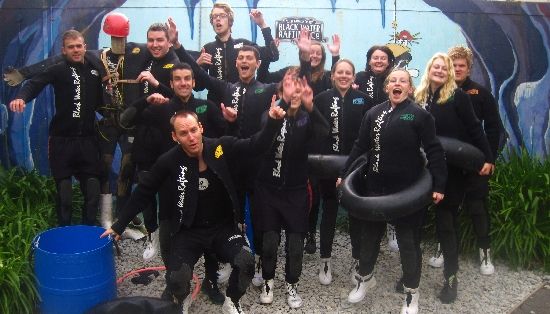
But the experience in between was amazing. After our instructions, we began to descend into the cave. We walked through tight openings and tunnels and waded through quick-moving and very cold water. Sometimes the water was ankle deep, other times chest height. Eventually, we came to the first milestone: waterfall #1. I met the waterfall with trepidation. My group, knowing my fear, encouraged me to go first, but that wasn’t going to happen. I went third. My fear was that I’d never jump far enough to clear the rocks. I didn’t jump far enough. As my tube landed in the water, my foot lightly touched the bottom rock.
From there, it’s an easy cruise through the cave, where above you, you begin to see glow worms like stars in the sky. They seemed limitless in number. It reminded me of my childhood when I used to put those glow-in-the-dark cosmos stickers on my ceiling and stare at them as they lit up my room.
But the day’s biggest challenge lay ahead: waterfall #2. This waterfall was much higher than the first, and to me, it might as well have been Niagara Falls. I had to make everyone count twice before I was ready to jump. Closing my eyes, I jumped, and this time I jumped far enough. But I hated every minute of it. I still prefer to have my feet on the ground.
Yet from here until the end it was smooth sailing…or tubing in this case. The rest of the way was all glow worms. Leaning back in my tube, I floated down the river, marveling at the beauty of the light show and the tranquility of my surroundings. But the tunnel’s end came too quickly, and I was left wanting to go back and stare upwards just a bit longer.

I can see why the glow worm caves are one of New Zealand’s biggest tourist attractions. They’re beautiful. The caves are peaceful. Overall, it’s an amazing experience. Three hours seemed too short, but five hours might have been a bit too long. I’d go back to see the glow worms again, and, whether you abseil, tube, or simply cruise in a boat, the glow worms are not to be missed.
How to Visit the Waitomo Glow Worm Caves
Waitomo is 200km south of Auckland. By car, it’s around a two and a half hour drive, while by bus it’s closer to 3 hours. Expect to pay around 35 NZD for a one-way bus ticket from Auckland. A bus from Rotorua will cost around 35 NZD each way.
Once you get to Waitomo, here are some suggested companies to visit the glowworm caves with:
- Black Water Rafting (the company I went with)
- Spellbound
- Caveworld
Prices will vary depending on the company and time of year but, generally, water tubing is 145 NZD per person, tubing and abseiling is 250 NZD per person, and a simple boat ride is 51 NZD per person.
While the glowworm caves in Waitamo are not a cheap activity, they are definitely one you should make an effort to do. You won’t regret it!
Book Your Trip to Waitomo: Logistical Tips and Tricks
Book Your Flight
Find a cheap flight to Waitomo by using Skyscanner or Momondo. They are my two favorite search engines. Start with Momondo.
Book Your Accommodation
You can book your hostel in Waitomo with Hostelworld. If you want to stay elsewhere, use Booking.com as they consistently return the cheapest rates. (Here’s the proof.)
Don’t Forget Travel Insurance
Travel insurance will protect you against illness, injury, theft, and cancellations. I never ever go on a trip without it. I’ve been using World Nomads for ten years. You should too.
Need Some Gear?
Check out our resource page for the best companies to use!
Want More Information on Waitomo?
Be sure to visit our robust destination guide on Washington, D.C. for even more planning tips!
The post Waitomo’s Glow Worm Caves appeared first on Nomadic Matt's Travel Site.


from Nomadic Matt's Travel Site https://ift.tt/2LPi3ox
Subscribe to:
Posts (Atom)