Monday, January 29, 2018

5 ways to differentiate your agency’s pitch

Every business needs paying customers—and for agencies, that means winning new, quality clients.

New accounts can bolster your reputation and typically leads to more growth with referrals and market visibility. The key for aspiring agencies hoping to land bigger and better accounts? An exceptional pitch.

When crafting a pitch, remember the golden rule: Pitch the way you would want to be pitched.

If you were an in-house marketer, you would want to know a prospective agency’s approach is rooted in data, evidence it completed the homework on both you and your competitors, and a fresh, authentic message.

In a recent survey by Vennli, an Indiana-based data insights platform, agency professionals and in-house marketers identified the following elements of an effective pitch:

1. Data wins projects.

When asked about the biggest mistakes an agency can make when pitching, “not showing how they plan to back up their claims to increase revenue,” was number one.

The survey also found that 70 percent of marketers expect primary research in pitches, and 75 percent of agencies said they conduct primary research.

The research shows in-house marketers expect from an agency what their management team expects from them: proof that marketing efforts have a return on investment.

2. If the client is important to you, be important to the client.

Few things make customers feel less like an individual and more like a sales lead than a copy-and-paste email campaign, and the same is true for a copy-and-paste pitch presentation. One of the best things an agency can do to differentiate itself from the competition is to take the time to produce a unique, thoughtful pitch for every potential client.

Thirty-six percent of agencies said that they’re always re-thinking the client’s entire strategy when developing a pitch. However, only 7 percent of marketers reported seeing this happen in all pitches, and 59 percent report seeing it only some of the time. No in-house marketer wants to award an agency their business if the project doesn’t feel important to the agency.

[RELATED: Learn how to boost buzz, build brand recognition and engage employees on the hottest social media platforms.]

3. To know the client, know the market.

It might seem obvious, but it’s essential to research the client’s competition. Eighty-two percent of marketers expect agencies to conduct primary research on their competitors as an element of the pitch; however, only 56 percent of agencies claimed to conduct such research.

Sixty percent of agencies with win rates above 50 percent said they always conduct competitor research. On the contrary, of the agencies with win rates below 40 percent, only 44 percent reported always conducting competitor research. Remember: an in-house marketer’s needs are a reflection of the competition.

4. Play the long game.

As stress and pressure mounts, it becomes easy for agencies to focus on short-term projects and push long-term plans to the back burner. But consider this: 40 percent of marketers reported putting their business up for review every one to two years, and 47 percent reported that the typical length of their relationship with an agency is between two to four years.

It is easier said than done, but agencies should approach every project as the beginning of a long-term relationship. Not only does this save time in the long run, it eliminates the need to re-develop strategy on the fly.

5. Be a consultant, not an advertiser.

In-house marketers reach out to agencies because they have a specific problem that needs to be solved. They don’t want to be sold; they want a solution.

An agency should serve as a subject matter expert that consults with the marketer and can pivot as necessary, bringing their market expertise with them. Forty-nine percent of marketers said the ability to “be flexible and redirect efforts if we need to change direction” is among the top three characteristics they seek in an agency.

At the end of the day, an agency is more than a megaphone for their client’s messaging. They’re a consultant, willing and able to use their expertise to solve problems at every turn.

Mary Claire Mandeville heads up Vennli's agency practice and has her MBA from the University of Notre Dame.

(Image via)


from PR Daily News Feed http://ift.tt/2DN0SoB

USA Gymnastics and Michigan State University have ‘long road’ ahead after Nassar case

Officials for USA Gymnastics and Michigan State University are scrambling—but their reputational crises seem unlikely to end anytime soon.

On Jan. 24, former USA Gymnastics team doctor and MSU assistant professor Larry Nassar was sentenced to 40 to 175 years in prison after pleading guilty to seven counts of first-degree criminal sexual conduct.

IndyStar reported :

Nassar's downfall started in March 2016 , when IndyStar published its " Out of Balance " series, investigating USA Gymnastics' broken policies for handling sexual abuse. IndyStar continued to cover the case, alongside other reporters from the USA Today Network, including the Lansing State Journal, which is where the trial took place.

… IndyStar's reporting continued, all the way through the sentencing hearing, in which more than 150 women shared their experiences of abuse. Nassar assaulted the athletes he treated while working for both USA Gymnastics and Michigan State University.

USA Today reported :

USA Gymnastics initially told IndyStar it contacted the FBI "immediately" after learning of athlete concerns about Nassar's treatment, but later acknowledged it waited five weeks while conducting its own investigation. Texas law requires "any person suspecting that a child has been abused or neglected must immediately make a report."

As the crisis grew and Nassar’s sentencing drew near, USA Gymnastics distanced itself from several leaders—but cries for the organization to take further action continued.

On Jan. 18, USA Gymnastics cut ties with Karolyi Ranch , where many of the alleged assaults by Nassar occurred. On Jan. 22, three board members resigned , and the coach of 2012’s U.S. Olympic gymnastics team was suspended.

On Jan. 26, the board announced its remaining members will resign by Jan. 31 in response to an order by the U.S. Olympic Committee.

NPR reported :

Informing USA Gymnastics of the required resignations, USOC CEO Scott Blackmun cited the "shocking and tragic stories surrounding Larry Nassar's years-long abuse of vulnerable athletes." In the letter he sent to the gymnastics organization, he added, "We must take further action to ensure that it cannot happen again."

The crisis has caused several sponsors to withdraw from the organization, as well.

Uproxx reported :

The same day that former USA Gymnastics team doctor Larry Nassar was sentenced to up to 175 years in prison for years of sexual abuse against current and former Team USA members, AT&T announced it had cut ties with the troubled organization. The Texas-based telecommunications giant became the fifth major corporation to sever its business connections to USA Gymnastics. According to ESPN , Under Armor had previously decided to end its partnership with the organization early, whereas Hershey, Kellog, and Procter & Gamble decided not to renew their respective deals.

The Dallas News reported :

In a statement, the Dallas-based telecom giant said it is "suspending our sponsorship of the organization until it is re-built and we know that the athletes are in a safe environment."

… “The terrible abuse suffered by these young women is unconscionable,” AT&T said in a statement. “We remain committed to helping these young athletes pursue their dreams and hope to find other ways to do so. We stand ready to step back in when USAG has fully addressed these tragic events.”

The Detroit News reported :

Losing corporate partners is a significant blow to the organization. Sponsorships and marketing accounted for about a quarter of USA Gymnastics’ $23.7 million of recorded revenue in 2015, according to the Orange County Register.

Many of the gymnasts who were abused by Nassar are also suing USA Gymnastics, accusing the organization of not doing enough to prevent the assaults, or of allowing them to continue. Earlier this week, the federation’s chairman Paul Parilla, vice chairman Jay Binder and treasurer Bitsy Kelley announced they were stepping down. John Geddert, the coach of the 2012 U.S. Olympic team who’d hired Nassar at his Michigan gym, was suspended.

[FREE DOWNLOAD: Keep your cool in a crisis with these 13 tips.]

As additional criminal and civil lawsuits are filed, USA Gymnastics PR nightmare continues to fester.

USA Today reported:

And the Indianapolis-based nonprofit — once a cash-rich darling of the Olympic movement — is now squeezed between a self-inflicted public relations nightmare and a host of lawsuits that could cripple it for years.

The problem, experts say, is USA Gymnastics officials need to be transparent if they hope to regain the public’s trust, while the lawsuits prohibit them from saying anything that would amount to an admission of guilt.

"Often in a crisis communications situation you will have the public relations folks in conflict with the general counsel or the attorneys," said Michael Wyland, partner in Sumption & Wyland, and consulting editor of Nonprofit Quarterly. "Both are looking at the best interest of the corporation, but they see the best interest of the organization in very different ways."

USA Today said USA Gymnastics has “a long, tough road at best” ahead of it.

Resignation letter and silence erodes trust for MSU

Crain’s Detroit Business reported that MSU also had a “long, complex road ahead” as it tries to regain trust after Nassar’s sentencing.

Crain’s wrote:

In the aftermath of the Nassar criminal verdict and sentencing, the university is working to reduce huge liabilities from civil court lawsuits and scrapping with insurers, which may be on the hook for hundreds of millions of dollars, as the wounds of losing in the court of public opinion mount.

It won't be simple, or cheap. It may be years before it's all resolved. And anything MSU does to reduce its ultimate costs — vigorously fighting victims' claims in court, for example — risks a backlash that could further hammer its reputation.

University leaders’ communications up to this point have not helped stemmed the tide of criticism that continues to grow.

The Detroit News reported :

MSU spokesman Jason Cody said the school responded vigorously once Nassar’s crimes came to light in 2016. He said campus police took 135 reports of criminal sexual conduct and executed a search warrant that contributed to Nassar’s convictions. MSU also established a $10 million counseling fund last month.

The Detroit News wrote that sexual misconduct reports about Nassar reached at least 14 MSU representatives, including former president Lou Anna Simon, before Nassar’s arrest:

Among those notified was MSU President Lou Anna Simon, who was informed in 2014 that a Title IX complaint and a police report had been filed against an unnamed physician, she told The News on Wednesday.

“I was informed that a sports medicine doctor was under investigation,” said Simon, who made the brief comments after appearing in court Wednesday to observe a sentencing hearing for Nassar. “I told people to play it straight up, and I did not receive a copy of the report. That’s the truth.”

Simon told reporters she fired Nassar “the day she knew about [the allegations]”:

<iframe title="DETROITNEWS- Embed Player" width="540" height="350" frameborder="0" scrolling="no" allowfullscreen="true" marginheight="0" marginwidth="0" src="http://ift.tt/2DKNihf>

On Jan. 24, Simon resigned— publishing a letter on MSU’s website which read, in part:

The last year and a half has been very difficult for the victims of Larry Nassar, for the university community, and for me personally. To the survivors, I can never say enough that I am so sorry that a trusted, renowned physician was really such an evil, evil person who inflicted such harm under the guise of medical treatment. I know that we all share the same resolve to do whatever it takes to avert such tragedies here and elsewhere.

… As tragedies are politicized, blame is inevitable. As president, it is only natural that I am the focus of this anger. I understand, and that is why I have limited my personal statements. Throughout my career, I have worked very hard to put Team MSU first. Throughout my career, I have consistently and persistently spoken and worked on behalf of Team MSU. I have tried to make it not about me. I urge those who have supported my work to understand that I cannot make it about me now. Therefore, I am tendering my resignation as president according to the terms of my employment agreement.

Anyone who knows me knows I am a principled person. I have spent my entire professional career, more than 40 years, at MSU. I love this place. I have watched it grow and prosper, and it has been the honor and privilege of my life to serve as its president since 2005, and over the last few years, to have the opportunity to work with all of you toward our shared goals for MSU. I will continue to do whatever I can to help MSU prosper in the future as a Spartan in whatever role I may play.

The letter brought further criticism upon Simon and leaders of the university.

In a Detroit Free Press column titled, “ Here’s what’s wrong with Simon’s resignation letter ,” PR pro Matt Friedman wrote:

Resignation letters that are intended for public view are typically last gasps of leadership. They are often the first step in helping an organization close one chapter and move into another. They are typically written succinctly, following the adage that “less is more.” But Simon chose arrogance over humility, defensiveness over compassion and callousness over sensitivity, in a lengthy recitation.

Here we are, a day after the letter was posted, still reading about it — still thinking about it — rather than the university’s plans for the future. That proves Simon's resignation letter did not achieve what should have been its objective.

How would you advise leaders at USA Olympics and Michigan State University to handle this crisis and try to win back its audiences’ broken trust?

(Image via)

Copyright: zhukovsky / 123RF Stock Photo

from PR Daily News Feed http://ift.tt/2npbDCp

7 smart strategies for success on the new-look Facebook

If you’re like most communicators, you did your 2018 strategy planning—only to have Facebook announce it was changing the game for organizations again.

If you’re going back to the drawing board, you’re not alone. Facebook continues to tinker with its platform and that means everyone must adapt.

“I’m changing the goal I give our product teams from focusing on helping you find relevant content to helping you have more meaningful social interactions.”

Mark Zuckerberg, CEO of Facebook

Not that organic reach for organizations on Facebook hadn’t already fallen by half over the past three or four years. Smart and strategic communicators were able to drive engagement and ensure that, despite falling reach and lower visibility, their content was attracting engagement and staying on the good side of Facebook’s algorithm.

Now, however, Facebook has put brand managers on notice that the paltry 2 to 6 percent reach they were averaging is too high and degrades the “Newsfeed” experience for average users. Going forward, branded content will be further suppressed in newsfeeds while posts from friends and family will be given more visibility.

What are marketers to do after Facebook’s changes drastically limit their organic reach? Here are seven tips for keeping your Facebook presence alive:

1. Commit to quality over quantity, if you haven’t already.

Unless it’s exceptionally engaging (think animals, kids, heroes and other phenoms, kickboxing octogenarians, etc.), your content may not be seen by sufficient numbers to justify the effort it took to create that content. Worse, if your content isn’t regularly engaging people, you’ll be digging yourself a deeper hole. Facebook’s algorithm will dock your brand for content that doesn’t engage and will further suppress it.

2. Embrace video, particularly Facebook Live.

Facebook Live videos are expected to remain a powerful engagement tool. Currently, when you launch a Facebook Live video stream, Facebook alerts your followers, which can raise your page’s visibility and get your content in front of more followers.

In looking back at 2017 content, we noted that paid promotion generated quadruple the number of organic video views. If you’re going to put the time into creating videos for Facebook in 2018, plan to support them with paid promotion too.

3. Explore cause marketing partnerships.

If you’re an accounting firm, manufacturer or an IT company, it’s going to require constant creativity to keep your content engaging. However, nonprofits have a better shot because causes typically are more engaging than products and services.

Nonprofits can benefit from the reach, budgets and skills of their for-profit partners on Facebook, while for-profits can benefit from the engagement and interest generated by their cause partners.

[RELATED:  Learn how to boost buzz, build brand recognition and engageemployees on the hottest social media platforms.]

4. Know your audience.

The first rule of good communication has always been to know your audience. That has not changed with the advent of social media, nor does it change now.

Look at what has resonated with your audience in the past on Facebook. Do some digging to find out what your audience is struggling with or what excites them. Your Facebook data and customer research are a treasure trove of content ideas that can connect with your followers.

5. Recognize that Facebook is a paid platform and leverage its promotional tools.

All organizations have promotional messages that they must distribute to show ROI on their social media investment, but just as with traditional media outlets, you’ll need to pay Facebook to deliver those messages to your followers. That is the clearest impact of Facebook’s changes—despite its protestations to the contrary.

6. Prioritize influencer engagement and think more widely when it comes to influence.

Looking back on the content we shared over 2017, the post with the greatest reach featured a testimonial video message from a celebrity. Other top posts by reach in 2017 were those that we tagged with other brands or real people.

Connect your content to real people whether they’re employees, customers, donors, celebrities or community leaders . Likewise, equip and mobilize your organization’s stakeholders so that they can share and amplify your messages on social media. For your content to be meaningful, it must feature real people and brand relationships, and not simply be a brand billboard.

7. Look at every post as a conversation starter—but don’t ask for shares.

Brand managers should post Facebook content that starts conversations and is worthy of sharing. Invest some time in generating ideas for thought starters you could share. Facebook’s algorithm will also be looking at how quickly people respond to your posts and elevating posts based on the quality of comments and not the number of likes.

We noted in 2017 that posts generating a high volume of comments on our pages tended to appeal to followers’ nostalgia and encouraged them to share memories. They also gave followers an opportunity to share personal achievements and stories of interest to other page followers.

How can your Facebook page give its followers opportunities to share their experiences or knowledge, be recognized by others or connect with like-minded people?

A few missteps to avoid : Don’t start a conversation at 5 p.m. and let comments go without a response until the next morning. The Facebook algorithm pays attention to how quickly you respond and rewards fast responses and exchanges in the comments.

Also, be careful not to ask for shares or comments: Facebook’s algorithm will punish posts that overtly ask, “share this.”

What about you, PR Daily readers? How are you preparing for Facebook’s changes in 2018?

Julie Wright is president and founder of (W)right On Communications, Inc., a strategic communications firm celebrating 20 years with offices in Los Angeles, San Diego and Vancouver. Follow her on Twitter @juliewright. A version of this story originally appeared on the author's blog, (W)right On Target.

(Image via)


from PR Daily News Feed http://ift.tt/2nk9wQZ

As #GrammysSoMale trends, academy chief throws gasoline on the fire

The group representing the music industry has proven itself tone-deaf.

After the Grammys program concluded Sunday night, with Bruno Mars grabbing many awards and men taking home most of the trophies, a Twitter hashtag (#grammyssomale) called out a gender gap in recognizing accomplishments in music.

Every show business awards group should prepare for a discussion about gender parity, but it seems the Recording Academy got caught off guard.

The official response, from academy president Neil Portnow, was to say that women have to work harder and be more creative.

The Twitterverse wasn’t pleased with the Grammys programming, nor the subsequent messaging, in light of the #MeToo movement and cultural reckoning with gender disparity.

Others were furious that New Zealand singer Lorde, the only female artist in the running for Album of the Year, was not offered a solo performing slot.

E! News reported:

While fans were hopeful that the "Green Light" singer was going to sing at the 2018 Grammys, multiple reports say it just won't happen this year.

TMZ reports that Lorde was hoping to perform one of her songs from her nominated album Melodrama. After all, she is nominated for Album of the Year.

But according to Variety, Lorde was only approached to perform with other artists during the tribute to the late Tom Petty. The song she was reportedly offered to sing was "American Girl."

Artists tried to have their own #MeToo moment at the Grammys, wearing white roses as a sign of support for the Time’s Up initiative—but the awards and the messaging from the Recoding Academy sent a different message.

USA Today reported:

"I think it has to begin with women who have the creativity in their hearts and their souls — who want to be musicians, who want to be engineers, who want to be producers, who want to be part of the industry on an executive level — to step up, because I think they would be welcome," [Academy president Neil Portnow] told journalists backstage after the show.

"I don't have personal experience with the kinds of brick walls that (women) face," Portnow continued. "But I think it's really a combination of us in the industry making a welcome mat very obvious: creating mentorships, creating opportunities, not only for women, but for all people. And moving forward, creating that next generation of artists who feel like they can do anything and say anything."

The Recording Academy did not offer Lorde an apology for the performance snub.

USA Today continued:

Grammys producer Ken Ehrlich was asked more bluntly by another reporter whether it was "a mistake" to not invite Lorde to perform.

"I don't know if it was a mistake," Ehrlich said. "These shows are always a matter of choices, and we know we have a box and the box gets full. She had a great album, but there's no way we can really deal with everybody. Overall, we did the best we can to make sure it's representative of our show."

[FREE DOWNLOAD: 13 tips for preparing for a crisis]

The message from the Grammys leadership was seen as woefully tone-deaf and ignorant of the current cultural moment:

Others tweeted stats to illustrate the gender gap:

Now the academy must try to walk back some of Portnow’s words or address the gender gap in other ways.

Other industry groups should take note: A lack of honest messaging about gender and sexual harassment will not slide this year, and key spokespeople should craft astute and sensitive responses for the hard questions they will face.


from PR Daily News Feed http://ift.tt/2Gtgrzo

Guidance for using humor in marketing emails

We all love a good laugh.

Even the most serious email marketers (and customers) enjoy levity. Humor has long been a vital part of marketing. When it comes to email marketing, it’s often the message with the funny gag or gif that cuts through inbox clutter.

[RELATED: 10 ways to help your email engagement skyrocket]

Here’s how five companies are using humor to build their brand and enhance email engagement:

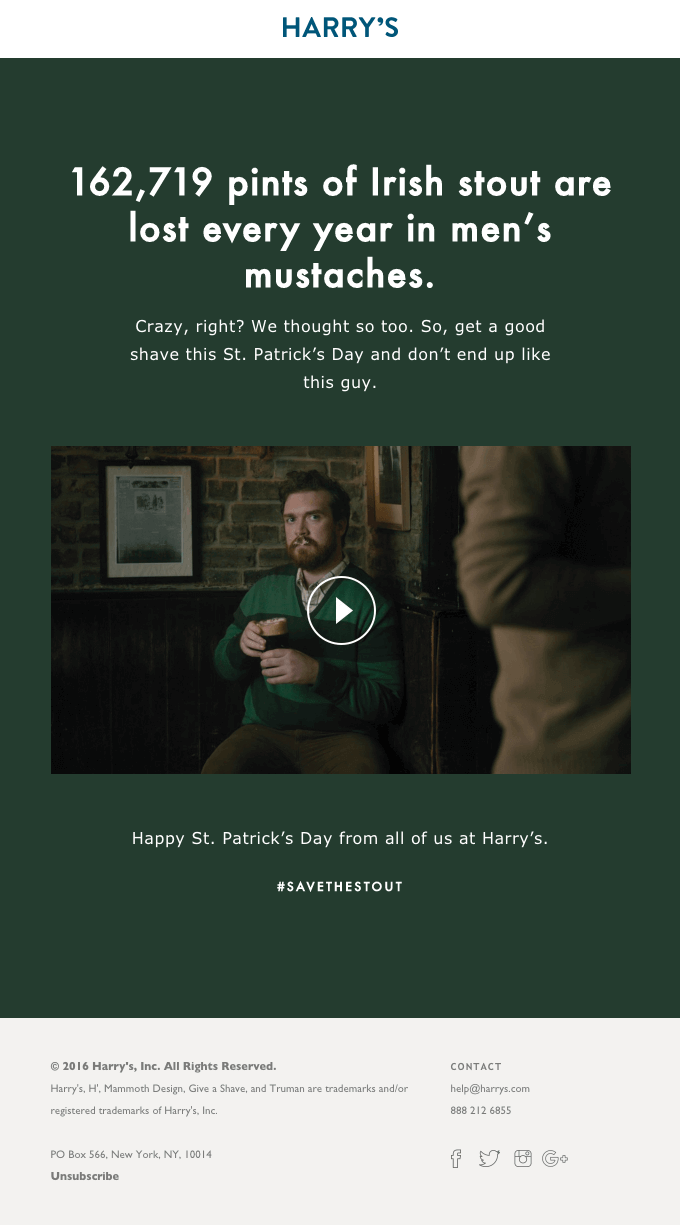
Harry’s
Harry's-humorous-email

That email from Harry’s, sent before Saint Patrick’s Day, takes the cake—and the stout. While wishing their subscribers good tidings on the special day, Harry’s offers a perfect product tie-in.

Short, punchy copy, a funny video, a perfect use of the hashtag #savethestout—everything about this email works. However, one important thing is missing: the call to action.

Poncho
Poncho-humorous-email

Poncho sends personalized weather alerts to its subscribers. What sets its email apart is their whimsical, wry writing. Who said weather reports have to be boring?

Poncho’s copy is an amalgamation of facts and suggestions, but with a comical touch. Poncho also uses bizarre hero images that bring a smile. There’s also space for enlisting other ways to connect with the company, which ensures better engagement with the brand.

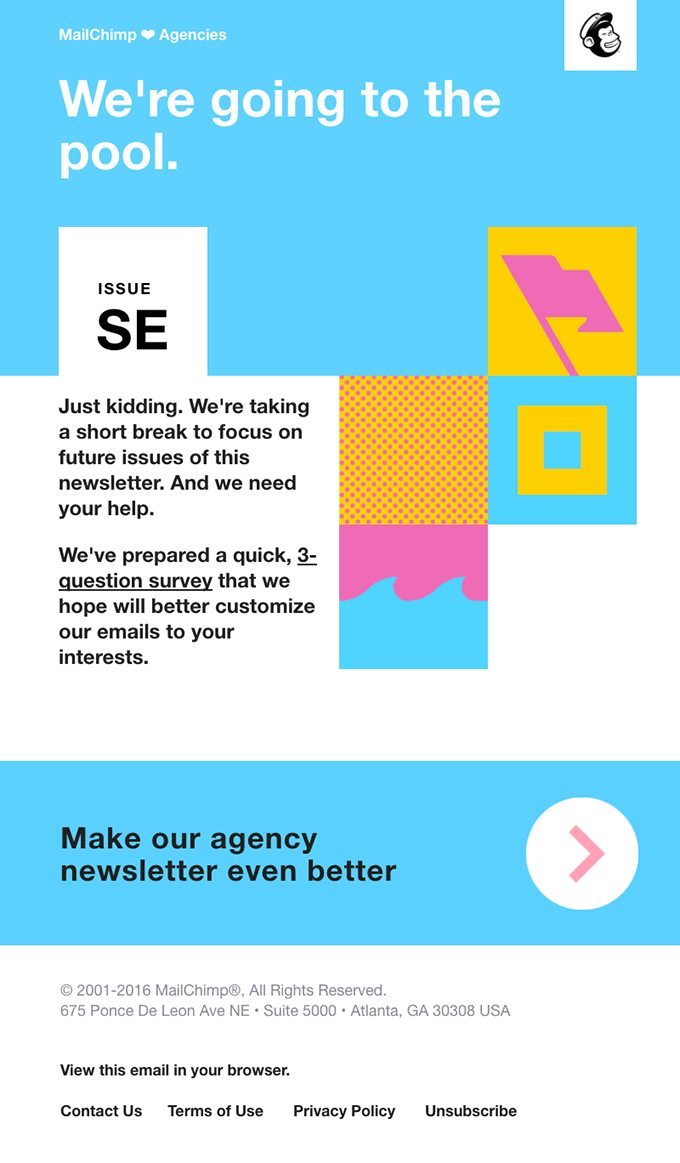
MailChimp
Mailchimp-humorous-email

MailChimp certainly knows how far you should take humor in emails. It’s conducting a survey through this email to help them improve their newsletter. Though the humorous opening line grabs attention, it gets to the point quickly, prodding recipients to take the survey.

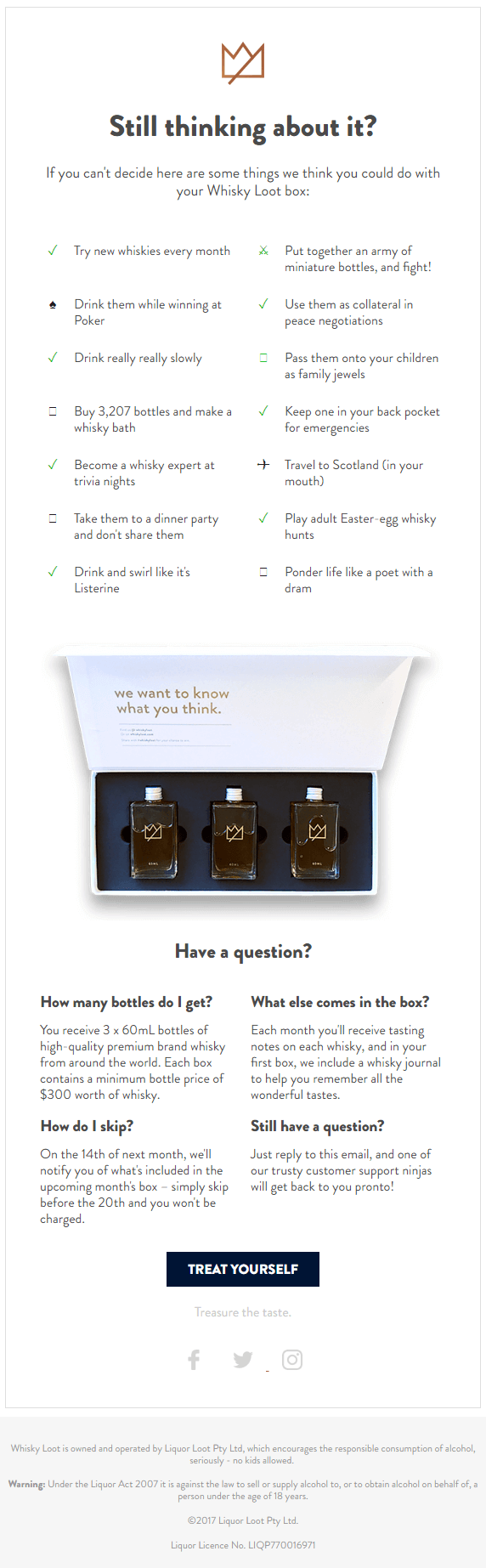
Whisky Loot
Whisky-Loot-Humorous-cart-abandonment-email

A cart-abandonment email must be about persuading the prospect to buy what they left in the cart, but the way you do it matters.

Whisky Loot’s brilliantly funny take on why the would-be customer should be buying from them is engaging and entertaining. The witty email copy ends by answering some frequently asked questions using a serious tone. Raise a glass for this email.

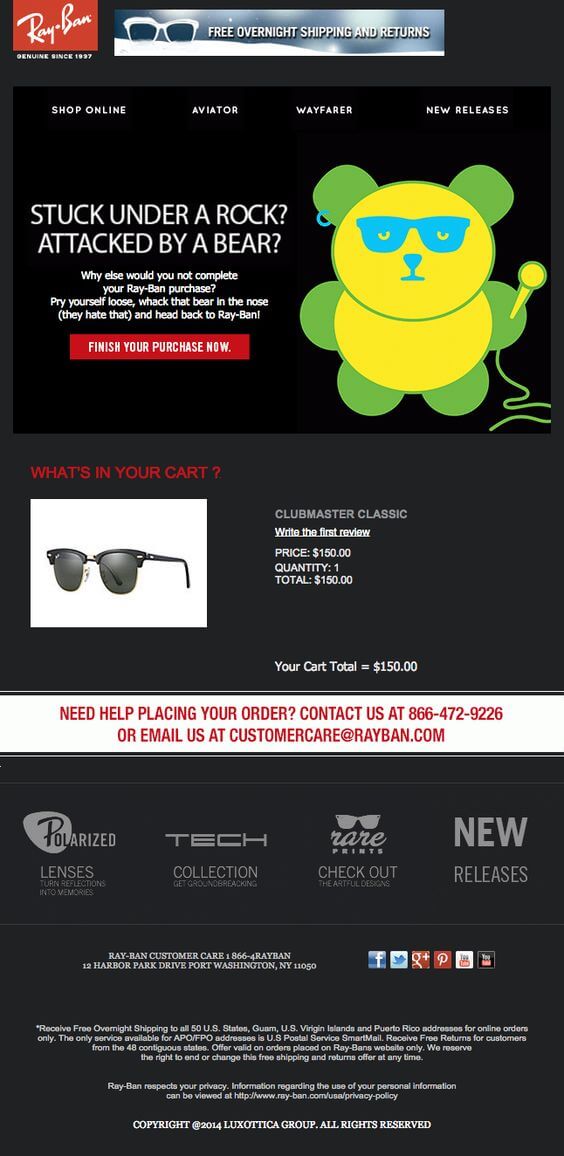
Ray-Ban
RayBan-Humorous-Cart-abandonment-email

Here’s another excellent cart-abandonment email. Ray-Ban’s way of nudging the customer to complete the purchase is funny and engaging, yet helpful without being pushy.

The company shows essential details of the abandoned product with a CTA to help them make the purchase without any hassles.

Expert tips on humor in email

The most important question you should ask yourself before using humor in your campaigns is: Is it relevant to your subscriber list, campaign idea and your brand image? Proceed only if the answer is yes.

Remember that not all your campaigns should have a humorous tone. You don’t want to lose the element of surprise. Also, because your primary goal behind an email is marketing, a joke without a marketing message is just a joke.

The idea is to subtly sprinkle humor into email campaigns—when appropriate—using it as a catalyst that encourages subscribers to click on your call to action.

Ideally, you should start small. Try using a conversational, warm tone in your email copy, and add subtle humor. Check the email performance to see whether you’ve found your subscribers’ funny bone. Another good practice is to A/B test. Pit a serious tone against a humorous tone, or try two different attempts at using humor in email.

Humor can help you cultivate a genuine connection with your subscribers, but it could backfire spectacularly. The last thing you want is to go viral for all the wrong reasons.

A good understanding of your audience is a must if you wish to incorporate humor into your strategy. Will they get the joke? That’s your responsibility.

Kevin George is the director of marketing at Email MonksA version of this post first appeared on the Email Monks blog.

(Image via)


from PR Daily News Feed http://ift.tt/2Egp9QF

Sunday, January 28, 2018

11 ways to amplify social media engagement

The goal of any social media pro is to increase online engagement—which, in turn, can boost your bottom line.

However, persuading consumers to interact with your social media posts—much less follow your calls to action—isn’t always easy.

An infographic from Red Website Design shares several takeaways to get started:

1. Know your target audience. Understand who your customers or clients are and what drives them. Otherwise, your content won’t appeal to their needs—and they’ll be less likely to share with friends and family. Twenty-six percent of people say they follow brands on social media that align with their interests.

2. Customize your content. Though nearly half of marketers (47 percent) say Twitter gives them the highest customer engagement, choose your platform(s) wisely, and tailor each piece of content to the platform. What works on Facebook won’t necessarily work on Instagram.

3. Surprise people. Don’t get into a content-creation rut; constantly think of ways to surprise consumers. Remember that readers love facts and statistics—especially if they’re about the latest trends.

[RELATED: Join us at Walt Disney World for the Social Media Conference for PR, Marketing and Corporate Communications.]

4. Create engaging content. Many communicators struggle to get their content seen in a sea of online chatter, especially when social platforms’ algorithms don’t favor branded content. To expand your reach, create excellent content that consumers must share with others.

5. Partner with influential social media users. Social media influencers can boost your campaign—and your brand. Most marketers (95 percent) say that influencer marketing is effective, so consider partnering with one to expand your reach.

6. Don’t forget a call to action. More than 90 percent of consumers who read your post’s headline will also read your call to action. Take advantage of their attention and tell them exactly what you’d like them to do.

7. Remember, timing is everything. Social media posts published from 1 p.m. to 4 p.m. garner the highest click-through rates. If you’re looking to make a splash on Facebook, post your content on Wednesday afternoons.

8. Embrace video. With Facebook users watching roughly 8 billion videos each day, brand managers who don’t create video content are missing out. It can also boost your engagement, as four times as many consumers would watch a video about your product instead of reading about it.

9. Get insights from industry communities. Join groups across online platforms that are relevant to your organization or client, and interact with members there. Your next comment might just open the door to a new contract or opportunity.

10. Share outstanding content. The more outstanding your content, the more probable it is that consumers will share it far and wide.

11. Ask for feedback. Don’t forget to ask your customers to write about their experiences online. The majority of consumers (88 percent) read customer reviews when deciding to frequent an organization, so take advantage of the power that word of mouth can have.

For more on these insights, check out the infographic below:


from PR Daily News Feed http://ift.tt/2FpwrB1

A Few Thoughts from Hacker Connect

As many of you know, Inman’s Hacker Connect was this past Monday in New York. A lively day of real estate tech discussion, I’ve put together a few thoughts:

Dr. Kate Stone, the founder of Novalia, showed the audience several interactive experiences. Her firm creates immersive, playable experiences connecting brands to audiences around the world.

See this video about Bud Light:

My initial reaction is this is a simple lead router, communications platform, and CRM — and similar to Quo. Long term, this is likely the beginnings of a RealScout competitor.

I led a roundtable discussion on thoughts on cryptocurrencies and the impact of blockchain technology on real estate. It was a great discussion with about 10 people (one of which had just worked on a successful ICO in another industry). Deed, title, and lending are huge areas for blockchain technology, however, there were other roundtables focused on those topics by themselves. We focused on a couple primary topics — one of which is partial / fractional ownership, seemingly the huge gigantic opportunity looming in the distance for blockchain technology. We also talked about ICO’s, and how we know whether we can trust the corporations/individuals behind them. It’s important to note ICO’s are more like a crowd funding vehicle than they are an instrument for equity investment (mostly due to legal complexity & financial investments regulation). There’s certainly still some confusion about what “blockchain technology” truly is — which is more a protocol than a platform like Ruby on Rails.

There were multiple “live problem solving” sessions throughout the day. They went okay, but not great. Putting the audience on the spot to muster great problems on the fly didn’t go as well as planned. That said, the panels managed to provide value. Jess from First.io and Lucie Fortier from CoreLogic were the participants for the last one. They touched on the agent adoption problem facing the entire industry, mentioned looking for great partners and/or an advocate as the best ways to break through the noise (I agree & am still shocked more don’t invest heavily on that front). There’s a crucial problem not enough founders ask themselves: “am I solving a real problem?”. They both stressed the need to re-communicate the value proposition over and over to customers and ensure the “why use the product” question is crystal clear.

Afterwards, many of the day’s folk met at BarBacon for drinks…

I met Adi Pavlovic, director of Keller Williams’ Innovation Lab. Given my personal focus on product innovation, it surprised me I somehow didn’t know Keller Williams had an innovation lab prior to seeing Adi moderate a discussion earlier in the day. In my defense, the innovation lab is less than a year old.

I met one of Geek Estate’s members in person for the first time: Peter Liem from Rukko. Spoke at length with a few team members from Buyside and Tribus (Eric Stegemann and Chuck Williams are both Geek Estate members as well), and caught up with my old colleague Sara Bonert at Zillow Group.

I met Florian, the product manager at Realigned (a previous consulting client).

That’s a wrap. Looking forward to seeing everyone again in San Francisco this summer!

The post A Few Thoughts from Hacker Connect appeared first on GeekEstate Blog.


from GeekEstate Blog http://ift.tt/2ByYEmI